

Food Security
Food security occurs when all people have reliable access to affordable, safe, and nutritious foods that meet their dietary needs so that they can live a full life. Based on 2021 Census Bureau data, 1 in 10 U.S. households reported low food security or uncertain access to affordable, nutritious food. Given that access to safe and nutritious food is foundational for good health across the lifespan, Title V Maternal and Child Health (MCH) programs have the opportunity to address social determinants of health, support community leaders, and create long-standing partnerships with other jurisdictional agencies in creating sustainable pathways in food access.
AMCHP is dedicated to highlighting policies and practices that promote community-based and relevant population-health solutions as one strategy to support Title V MCH programs in addressing inequities in food security. AMCHP’s approach to increasing food security includes uplifting the existing community-rooted organizations and families whose well-being has been impacted by low food security and working alongside them as partners.
Office of Disease Prevention and Health Promotion. Food Insecurity. Healthy People 2030. U.S. Department of Health and Human Services.https://health.gov/healthypeople/priority-areas/social-determinants-health/literature-summaries/food-insecurity
Coleman-Jensen, Alisha, Matthew P. Rabbitt, Christian A. Gregory, Anita Singh, September 2022. Household Food Security in the United States in 2021, ERR-309, U.S. Department of Agriculture, Economic Research Service. https://www.ers.usda.gov/webdocs/publications/104656/err-309.pdf?v=3770.3
Rosenberg, J. (2021, February 16). What Is Colonialism? ThoughtCo. https://www.thoughtco.com/colonialism-definition-and-examples-5112779

MCH Resources for Increasing Food Security
Title V Food Security Snapshots
AMCHP conducted an environmental scan of all 59 state and jurisdictional programs’ fiscal year (FY) 2021 Annual Reports and FY 2023 Applications available through the Title V Information System (TVIS) to document Title V MCH Block Grant program strategies and activities that address food security.
AMCHP did a key terms search using the following terms: food security, food insecurity, and nutrition. AMCHP found there are currently five jurisdictions that have a State Performance Measure (SPM) prioritizing food security.
Below is a series of snapshots of each jurisdiction that currently has an SPM demonstrating the growing capacity of Title V programs to address food security. In each snapshot, you will find the selected jurisdiction’s priority, objective(s), and strategies/activities. The bolded text in the snapshots below is meant to emphasize jurisdiction partnerships and their role in addressing food security.
Navigate through the snapshots below to learn more:
 |
 |
 |
 |
 |
Sources:
Maternal and Child Health Bureau. Title V Information System. Rockville, MD: Health Resources and Services Administration. Available at: https://mchb.tvisdata.hrsa.gov/
AMCHP’s Project Highlights & Partnerships
In recent years, AMCHP has actively developed expertise in culturally relevant and equity-centered solutions for food security. Below is a non-exhaustive list of intentional partnerships and projects AMCHP has led or been a part of related to creating equitable food access.
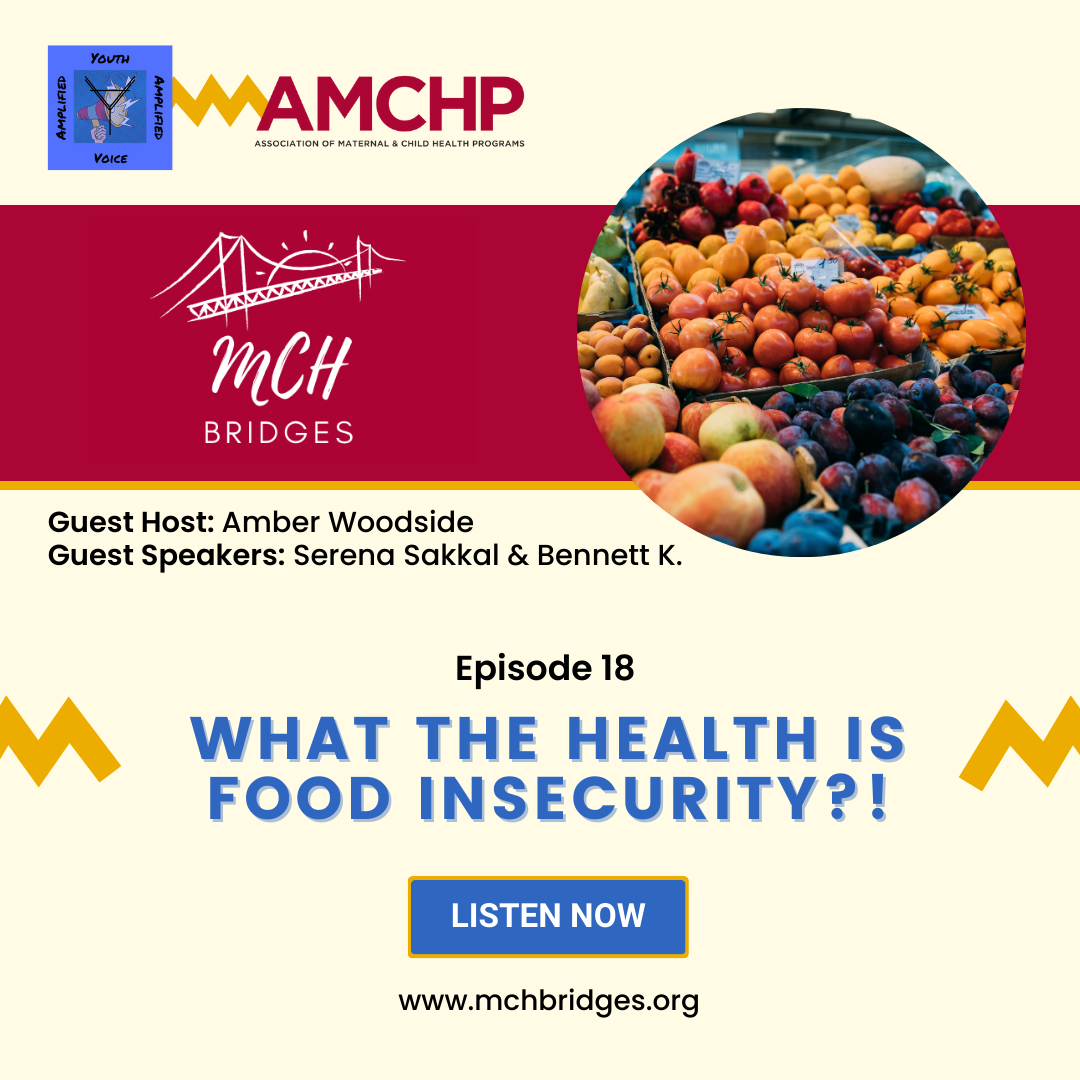 |
MCH Bridges and What the Health?! crossover Episode 18, led by AMCHP’s Youth Voice Amplified (YVA) committee, talks about the food insecurity crisis in the United States from a systems and lived experience point of view, and how these perspectives impact each other. This episode shares an overview of the state of food insecurity in this country, a background of different terms in the food justice space, and the inequities that present challenges for many in our communities. You will also hear about the importance of empowering communities and understanding solutions to accessing nourishing foods they connect with to create positive health outcomes. |
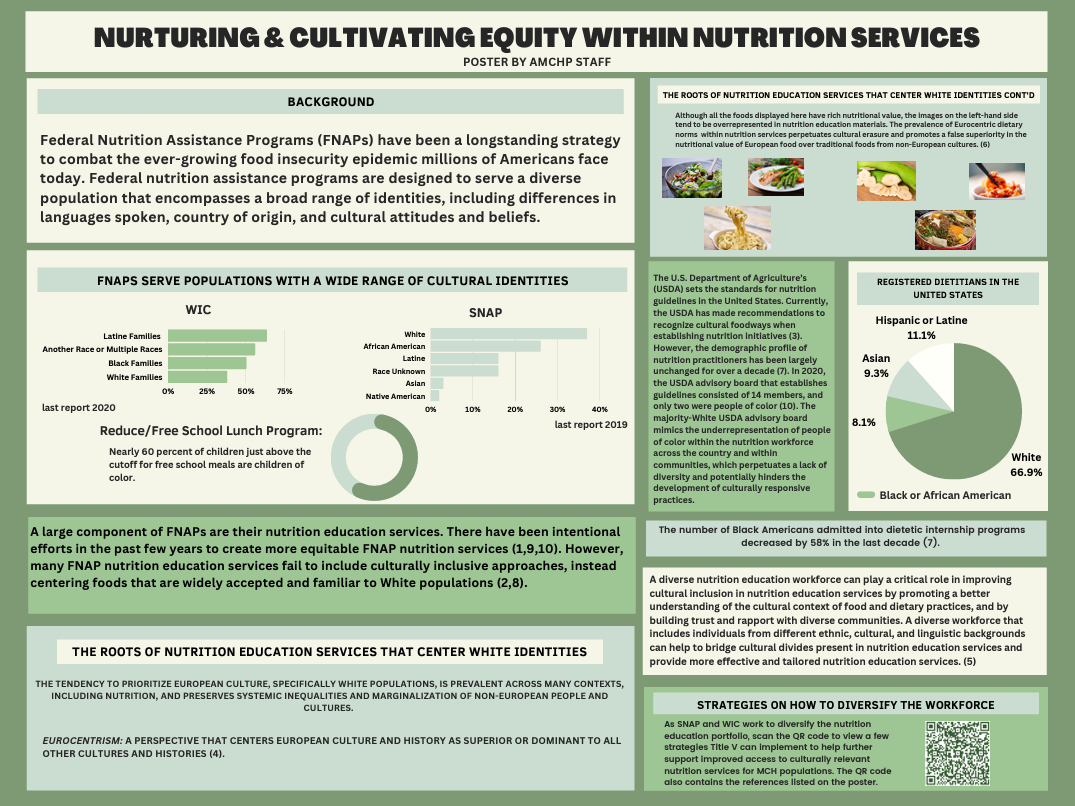 |
This Poster presentation from the 2023 AMCHP Conference discusses the need for more culturally inclusive approaches in Federal Nutrition Assistance Programs due to the emphasis on a more traditional westernized diet in nutrition education. This presentation highlights the underrepresentation of people of color in key decision-making roles within the nutrition field and emphasizes the importance of diversity in nutrition education to better serve culturally diverse communities. |
 |
On July 7, 2022, the Association of State Public Health Nutritionists (ASPHN) and AMCHP held an online meeting for the White House Conference on Hunger, Nutrition, and Health. People from different backgrounds, like healthcare professionals, community members, and those who have experienced hunger, talked in small groups and shared ideas about how to improve things. This document summarizes their suggestions in different categories. |
 |
AMCHP’s Title V and Early Childhood Nutrition Learning Modules: This set of five e-learning modules explains how Title V programs can incorporate early childhood nutrition initiatives into their programs. It offers practical examples of how policies, systems, and environmental changes can facilitate a smoother integration process. |
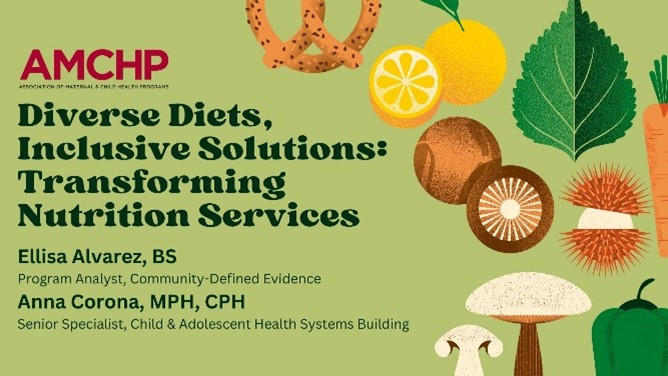 |
AMCHP staff were featured for the keynote address at the Iowa Institute of Public Health Research and Policy’s 2024 Healthy Lifestars Conference. This presentation emphasized the significance of integrating a cultural perspective into federal nutrition assistance programs aimed at advancing food security. Participants gained insights into racial and cultural inequities in nutrition strategies, learned to distinguish between inclusive and inequitable initiatives, and acquired resources for fostering community-engaged, culturally relevant approaches to enhance food security. |
Additional Resources
- The Association of State Public Health Nutritionists (ASPHN): ASPHN is a leading national organization on food and nutrition policy, programs, and services. Their mission is to improve public health by creating and strengthening equitable nutrition policies, systems, environments, and programs for all people through development of diverse public health nutrition leaders and collective action of members nationwide. Learn more about ASPHN on their website.
- ASPHN Food & Nutrition Security Primer: This resource helps you understand different terms related to food and nutrition security. You will find background information explaining why these are important, and there is a table with definitions of terms used by national food, nutrition, and health programs.
Food Security Practices and Programs Database
Welcome to our database designed to help you find practices and programs that promote equitable solutions in addressing food security. You can use this database to explore different approaches, filtering them by specific search terms and criteria, including community engagement, an equity and empowerment lens, state/international location, and ethnicity/race. You have the flexibility to choose from different search parameters to tailor your results to your specific needs and interests.
Once you have conducted your search, you will have the option to view all studies related to your chosen criteria. Within each study entry, you will find two views. The first view provides the title of the program or practice, allowing you to quickly scan for relevant initiatives.
When you select a specific program or practice, the second view will reveal a short, synthesized description of the project’s focus. For those who wish to delve deeper into a program or practice, there is a direct link to the article source where you can access more detailed information.
The summary below provides an overview of our literature review methods:
Through the CDC Public Health Associate program, AMCHP had access to the Stephen B. Thacker CDC Library, where an associate submitted a Literature Search Request using the following inclusion and exclusion criteria and keywords:
| INCLUSION CRITERIA (if one or more of the following criteria is met) |
EXCLUSION CRITERIA | KEYWORDS |
| Study provides solutions working towards dismantling food security | Study centers the discussion solely on food insecurity without discussion of solutions | Food access, food insecurity, socioeconomic, culturally inclusive, vulnerable populations, food dessert, food equity, community-led, community engaged, inequalities, programs, policies |
| Study is discussing culturally inclusive community-engaged approaches to address food insecurity | Study provides a broad overview of equity but does not address current programs or policies towards food equity | |
| Study addresses systemic and socioeconomic factors as contributors to the inequities in food access | ||
| Study provides programs or policies working towards food equity |
Through the Literature Search Request, AMCHP received around 558 title/abstracts meeting one or more of our inclusion criteria. From there, AMCHP reviewers selected about 106 abstracts for full text screening. Finally, 19 studies were selected to synthesize and include in the database.
* When synthesizing the selected studies, AMCHP used the Community Engagement (IAP2 Spectrum) and the Equity and Empowerment Lens to measure how these two selections criteria were met.